Typing Halal food near me in Richmond Hill into your phone gives you a map full of pins in about a second. What it does not give you is confidence. Some of those kitchens verify every protein they serve. Some serve halal chicken but not halal beef. Some cook a halal wrap in the same fryer that just handled bacon.
If you live in or around Richmond Hill, you have more options than you did five years ago. Those options only help if you know what to look for. This guide covers how halal claims work in Canada, what to check before you order, and why a kitchen where everything is halal changes the way you eat out.
Why the search results alone are not enough
Ontario is home to the largest Muslim community in the country. Statistics Canada found that 6.7% of Ontario residents identified as Muslim in the 2021 census, the highest share of any province. Demand grew fast. Restaurants responded just as fast.
Fast growth creates a gap. Menus and map listings use the word halal freely, but it means different things depending on who says it. For one owner, it means the meat arrives with certification paperwork. For another, it means they buy from a butcher a friend recommended. For a third, it means nobody ever checked.
That gap explains why two people can eat at the same restaurant and disagree completely about whether it was acceptable. They were not applying the same standard, and neither was the kitchen.
How halal claims are handled in Canada
The Canadian Food Inspection Agency treats halal as a claim with specific regulatory requirements. When a packaged food is labelled or advertised as halal, the name of the person or body that certified it has to appear alongside the claim. The agency does not set a national halal standard or approve certifiers. It only insists that the certifier be named so shoppers can judge for themselves.
Restaurants sit in a looser space. A menu is not a package label, and no inspector is checking the sign taped to the window. That is why the work falls to you, and why a kitchen’s willingness to show its certification matters far more than the sign in the window.
Halal food Richmond Hill: what the local scene looks like
Richmond Hill sits along one of the most varied food corridors in the region. Within a short drive, you can find Afghan kebab houses, Persian charcoal grills, Pakistani biryani counters, Turkish bakeries, and Lebanese shawarma shops. A single search pulls from all of them at once, which is part of why the results feel so scattered.
Compared with the broader halal food GTA picture, Richmond Hill leans toward owner-operated kitchens rather than chains. That is good news for quality. It also means standards vary from door to door, so knowing which places have committed to a full halal kitchen saves a lot of guesswork.
Where Toppings fits
If you would rather skip the checking altogether, Toppings on Elgin Mills Road East was built for exactly that. Every item on the menu is halal. Not the chicken only. Not most of it. All of it, which is what you are actually hoping for when you search for a 100% halal restaurant near me.
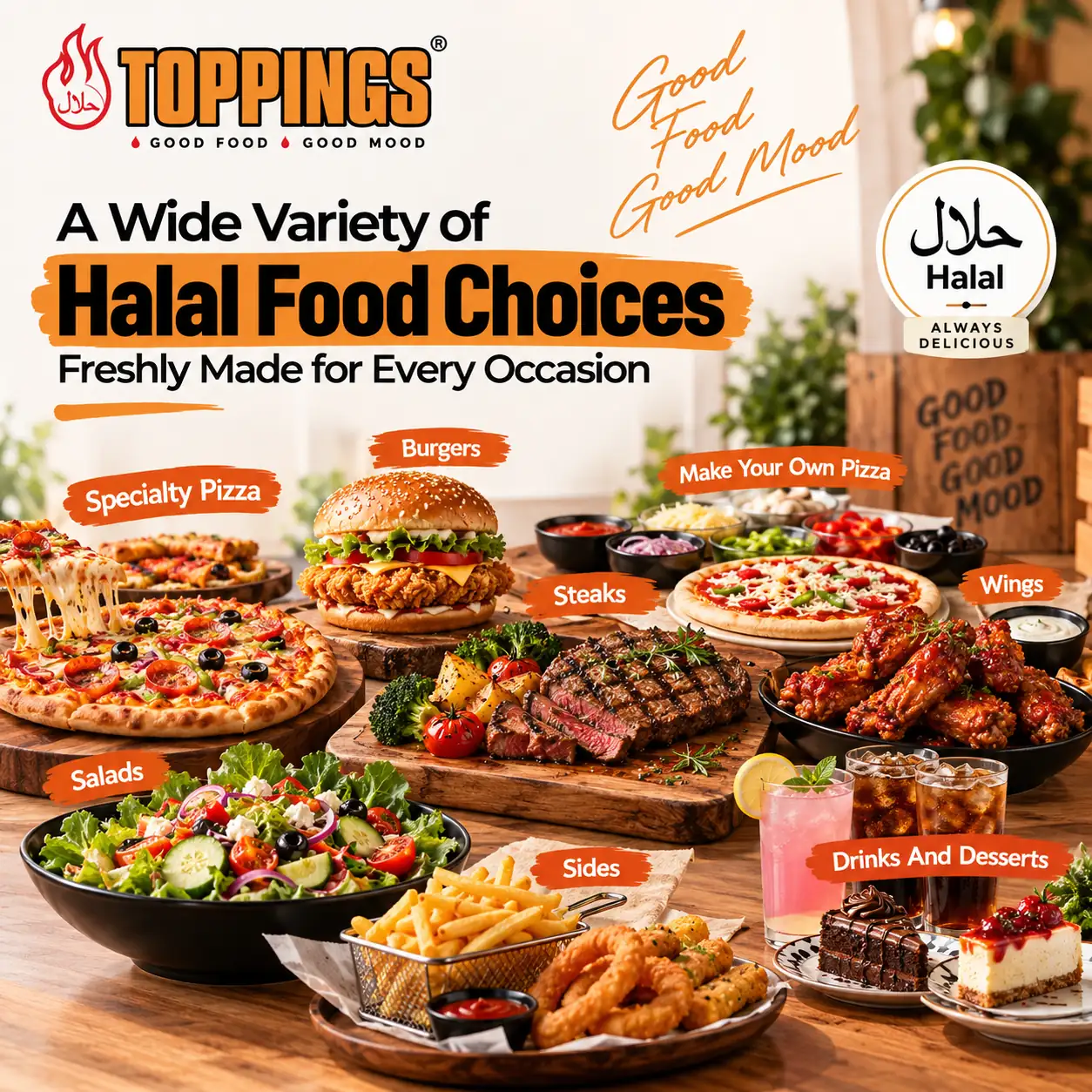
That covers the beef pepperoni and beef bacon on the pizzas, the steaks, the burgers and sliders, the wings, the East African short ribs and mishkaki, right down to the fries and the gravy. You can order anything on the full menu without cross-checking a single ingredient.
Types of halal spots you will find, and when each one works
Sit-down grills and family restaurants
These are usually the easiest to verify. Staff have time to answer questions, certificates tend to be displayed near the entrance, and the kitchen is often visible. If a place has been serving the same community for years, regulars will have asked the hard questions already.
Quick counters and takeout windows
Speed is the point here, which means less time to ask questions. If you are searching for halal takeout near me on a weeknight, do the checking once during a quieter visit and then order freely afterward. It is far easier to ask about fryers at two in the afternoon than during the dinner rush.
The same applies to halal fast food near me searches. Burger and fried chicken counters are where shared equipment causes the most confusion, because fries, onion rings, and chicken often move through one oil bath. At Toppings, the question does not come up, since there is no non-halal item anywhere on the line to separate from.
Delivery and app listings
Most delivery platforms let restaurants tag themselves with a halal label. Nobody audits that tag. When you search halal food delivery near me, treat the label as a starting point and not as proof. Checking the restaurant’s own website first is quicker and more reliable, and ordering directly usually gets your food out faster on a busy night.
How to verify a restaurant before you order
Ask to see the certification
Certification bodies such as the Halal Monitoring Authority inspect supply chains, check slaughter practices and carry out unannounced follow-up visits. A certified restaurant can show you the paperwork and tell you which body stands behind it. A generic halal sticker with nobody named behind it tells you nothing, so the question worth asking is simply whether they can produce it.
Ask one specific question
Instead of asking whether a place is halal, ask where the meat comes from and whether the certification can be shown. Staff at a careful kitchen answer without hesitating. Vague answers, or answers that change depending on who you ask, are a signal on their own. Toppings keeps its halal certification on hand and shares it with any guest who asks, so contact the team if you want the details before you visit.
Read reviews for the right signals
Skip the star rating and search the reviews for the words certificate, supplier, fryer, and pork. Reviewers who care about halal standards usually explain what they found. Two or three detailed reviews are worth more than a hundred ratings about portion size.
What experienced diners actually pay attention to
After enough restaurant visits, most people stop asking a single yes or no question and start looking at a handful of details instead.
- Fryer separation. A kitchen serving both halal and non-halal items needs separate oil, separate utensils, and separate prep space. Ask directly.
- Alcohol on the menu. This is a personal threshold rather than a fixed rule. Some diners avoid any venue with a bar; others do not mind as long as the food itself is verified. Decide where you stand before you go.
- Supplier changes. A restaurant that was certified three years ago may not be certified now. Certification lapses quietly.
- Who answers the question? If the owner answers confidently and the servers do not know, the standard may not be reaching the whole kitchen.
- Consistency across locations. A chain that certifies one branch has not necessarily certified the others. Each location is its own kitchen.
Common mistakes people make when searching
A search for halal restaurants near me produces a tidy list, and that tidiness is misleading. Here are the errors that come up most often.
- Trusting the map label. Business categories and attributes are often added by the owner or suggested by users, and they are rarely reviewed.
- Assuming cuisine equals certification. A Middle Eastern or South Asian menu is not automatically halal, and a burger and pizza menu is not automatically off limits.
- Assuming the owner’s background settles it. Plenty of Muslim-owned restaurants serve uncertified meat.
- Asking a community group instead of the restaurant. Crowdsourced answers age badly. The restaurant is the current source of truth.
- Checking once and never again. Suppliers change. A yearly recheck is reasonable for places you visit often.
A quick checklist before you order
Run through this the first time you visit somewhere new. It takes about two minutes.
- Can the restaurant produce its certification, or name the body behind it, when you ask?
- Is the certificate current rather than expired?
- Does the menu contain pork or alcohol, and if so, how is the kitchen separated?
- Is there a shared fryer, and are fried items cooked in it?
- Can a staff member name the meat supplier?
- Do recent reviews mention anything that contradicts what you were told?
- If you are ordering for a group, does the kitchen handle larger orders under the same standard?
Ready to Enjoy the Best Halal Food in Richmond Hill?
Finding trusted halal food in Richmond Hill should be simple. At Toppings, everything on the menu is halal, including pizzas, burgers, steaks, wings, and more. Whether you’re looking for a delicious meal for yourself or planning food for a birthday, corporate gathering, family celebration, or special event, you can also explore our halal catering options.
Skip the uncertainty and enjoy fresh, flavourful halal food prepared for every occasion. Contact us today to learn more about our menu and catering options, or visit Toppings and order your favourite halal meal.
Frequently asked questions
What does zabiha mean, and how is it different from halal?
Halal describes anything permissible. Zabiha refers specifically to the method of slaughter, including hand slaughter and the recitation at the time of slaughter. When people search for zabiha halal near me, they are usually looking for hand-slaughtered meat rather than machine-slaughtered meat. If this matters to you, ask about the slaughter method directly, because a restaurant may describe itself as halal without meeting the zabiha standard.
Does a certificate on the wall cover the whole menu?
Not always. Some certifications cover the meat supply only, not the desserts, sauces, or fried sides. Ask whether it covers the full menu or only specific proteins. A confident kitchen will tell you exactly what is included, and at Toppings the answer is everything.
Where can I check for halal options outside Richmond Hill?
The same method applies. Anyone asking where to find halal food in an unfamiliar city can start with the certification body’s list of certified businesses, then confirm with a phone call. Certifier lists are slower to update than review apps, but they are far more reliable.
Can I trust the halal filter on delivery apps?
Treat it as a shortcut for building a shortlist, not as verification. The filter reflects what the restaurant entered about itself. Confirm through the restaurant’s own site or a phone call before you become a regular.
Is halal meat more expensive?
Often slightly, because certification, inspections, and hand slaughter add cost. The difference at the till is usually small. A large price gap between two similar restaurants is worth a question rather than an assumption.
What about seafood and vegetarian dishes?
Most vegetarian dishes avoid the meat question entirely, but they can still be affected by shared equipment, cooking wine in sauces, or animal-derived stock. Ask about the sauce and the fryer rather than the main ingredient. The gravy at Toppings, for the record, is vegetarian.
How do Toppings handle a large group or an event?
Ask in advance whether the same standard applies to bulk orders, since some kitchens use different suppliers for volume. Halal catering from Toppings runs on the same menu and the same standard as the dining room, starting at six people. The full list is on the areas we serve page.