Ordering lunch for the team used to be an afterthought. Someone called in pizza, someone else picked up sandwiches, and nobody thought about it again. As offices have grown and diversified, that approach quietly stopped working, and business catering services became something worth choosing properly rather than defaulting to.
This guide covers what changes when you order food for a workplace rather than a party. Who gets left out and why it matters, how to build a menu that works for a mixed team, the logistics that actually decide whether lunch lands well, and what to look for in a provider you plan to use more than once.
Why office food stopped being a small decision
Two things happened at once. Teams got more diverse, and food became part of how workplaces signal who belongs. Ontario employers already have a legal duty here. The Ontario Human Rights Commission says employers have to make room for their staff’s religious practices, unless doing so would cause the business real hardship. The point is that nobody should have to choose between their beliefs and taking part fully at work.
Food is where this shows up most often and gets handled worst. Canadian HR Reporter has made the point that planning workplace food means checking a diversity calendar and being mindful of religious dietary practices, not just offering a vegetarian tray and hoping for the best.
The practical failure is rarely dramatic. Nobody complains. They just eat beforehand, skip the lunch, or take a plate and quietly leave most of it. Over a year of team lunches, that adds up to a group of people who learned the office events are not really for them.
What halal-friendly corporate catering gets wrong
The phrase sounds accommodating and often is not. Halal-friendly usually means a kitchen with a mostly non-halal menu that can put together something for you on request. It might be a vegetarian tray. It might be chicken from a different supplier, cooked on the same grill.
For a colleague who observes carefully, that is not a meal they can eat with confidence, and they are not going to make a scene about it in front of the team. The gap between a kitchen that can accommodate and a kitchen where everything is already halal is the difference between someone eating and someone politely not eating.
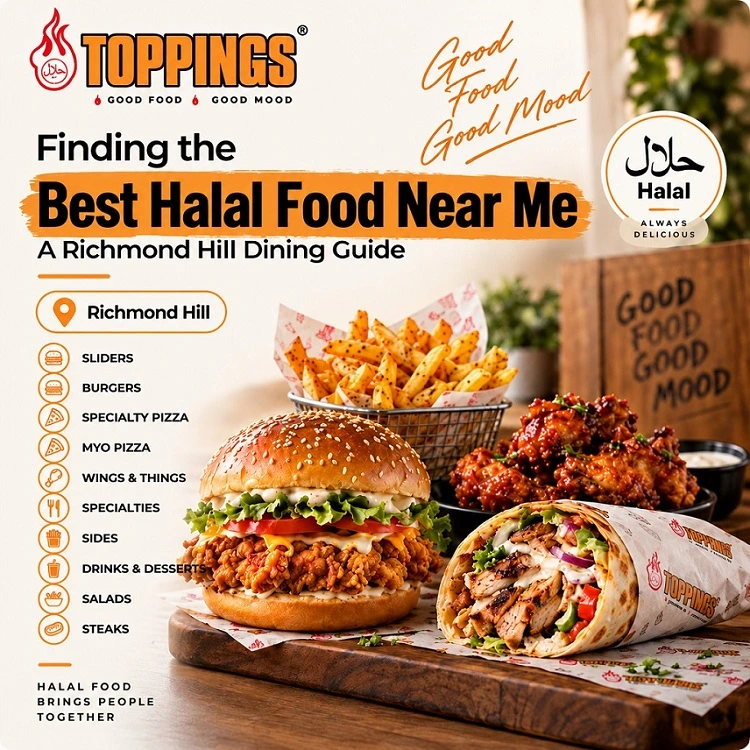
If your team includes people who keep halal, the simplest fix is to order from a kitchen where the question does not arise. Toppings is one such kitchen, and the practical effect is that everyone eats the same food, nobody gets a special tray, and no one has to ask.
The five kinds of office food orders
These have different requirements, and treating them the same is where most problems start.
- Client meetings. Small, high stakes, appearance matters. Individually packaged is safer than shared platters.
- Team lunches. Mid-size, informal, variety matters more than presentation.
- All-hands and town halls. Large, tight timing, needs to be served and cleared inside a break.
- Training days and workshops. Long sessions, so heavy food is a mistake. People need to stay alert after lunch.
- Recurring programs. A weekly or monthly lunch. Consistency and rotation matter more than any single order.
Recurring orders are where a good relationship pays off most. Group lunch catering for business teams works best when the provider learns your usual numbers, your delivery window, and your building quirks, rather than starting from scratch every time.
Building a corporate catering menu that actually gets eaten
Office menus fail in predictable ways. Too ambitious, too heavy, or too narrow. A few rules hold up.
- Two proteins minimum, with at least one chicken option, since it is the widest common ground.
- A real vegetarian main, not a side salad promoted to main course.
- Something familiar. Pizza, wings, and fries are clear plates in a way that fusion platters do not.
- Nothing that needs assembly at the table. People have twenty minutes and no counter space.
- Heat on the side, so the spice-tolerant and the spice-averse both get what they want.
- Food that holds. Grilled items and stews survive a delayed meeting. Anything crisp does not.
- Clear labelling on every item, so nobody has to ask what is in it in front of colleagues.
Catering for offices: the logistics nobody plans for
The food is usually fine. The logistics are what go wrong.
Delivery windows are the first issue. A meeting that starts at noon needs food by 11:40, not 12:00, because setup takes time. Give the provider a window rather than a moment, and tell them the hard deadline.
Building access is the second. Loading docks, service elevators, security desks, and visitor sign-in all add minutes. If your provider has delivered to your building before, that is worth more than a slightly better menu.
Numbers are the third, and hybrid schedules made this harder. People reply yes and then work from home, so order for who has confirmed plus a small margin, not for everyone on the team list.
Packaging is the fourth. Individually packaged meals cost more and waste less, work better for religious and allergy requirements, and suit client meetings. Shared platters are cheaper and more social. Pick deliberately rather than by default.
Budget, invoicing and the tax side
Corporate orders come with paperwork that private events do not. Ask early whether the provider can invoice on terms, issue a proper business receipt, and handle a purchase order if your finance team requires one. A caterer who only takes card payment at the door creates work for someone.
On the tax treatment, most business meals are only partly deductible. The Canada Revenue Agency lets businesses deduct only half the cost of food and entertainment, and it applies that to whichever is lower: what you paid or what it considers a reasonable amount for the occasion. There are exceptions, including certain all-staff events, so it is worth a short conversation with your accountant before setting an annual budget rather than after.
Keep the itemised invoice, not just the card slip, and note the business purpose. That habit costs nothing at the time and saves an argument later.
Choosing between corporate catering near me options
Shortlist on these, in this order.
- Can they meet your dietary requirements without a special arrangement?
- Have they delivered to your building or one like it?
- Will they commit to a delivery window in writing?
- Do they invoice properly?
- Is the menu wide enough that a monthly order does not repeat itself?
- Who is your contact, and does that person change every order?
Notice that food quality is not first. It matters, but a provider who nails the food and misses the delivery window twice will not survive in an office rotation.
How this works at Toppings
Measured against that list, here is what halal corporate catering looks like at Toppings, which caters to offices across Richmond Hill and the surrounding municipalities.
Everything is halal, restaurant and catering alike. There is no separate supplier for bulk orders and no accommodating tray on the side. For a mixed team, that means one order everyone eats from, which is both simpler to arrange and better received than a segregated arrangement.
The range is unusually wide for a halal kitchen, which matters for recurring programs. Pizza and wings, burgers and sliders, AAA steaks, salads and sides, plus East African dishes that most office menus never offer. A monthly rotation can run for most of a year without repeating. You can see the full menu to judge whether it suits your team.
Packages are built around your guest count rather than a fixed list, which suits offices where attendance moves week to week. The corporate catering page covers how business bookings work, and the areas we serve page confirms delivery reach if your office sits outside Richmond Hill itself.
Mistakes that cost teams more than money
- Treating halal as a special request rather than a default the whole order can meet.
- Ordering for the whole team when half of them are working from home that day.
- Booking delivery for the meeting start time rather than twenty minutes before.
- Skipping labels, then making people ask about ingredients in front of colleagues.
- Choosing the cheapest quote without checking what is included.
- Running the same three dishes every month until nobody shows up.
- Leaving catering to whoever is most junior, with no budget and no notice.
Your ordering checklist
- Confirmed numbers, not the full team list
- Dietary requirements gathered privately, in advance
- Delivery window agreed, with a hard deadline stated
- Building access, parking and elevator details passed on
- Packaging decided: individual or shared
- Labelling confirmed for every item
- Invoice terms and any purchase order sorted
- Named contact on both sides
Getting Office Catering Right, Repeatedly
The measure of good catering services is not one impressive lunch. It is thirty ordinary ones that arrive on time, feed everybody in the room, and never become a topic of discussion. That comes from choosing a provider whose menu, service, and process already match your team’s needs rather than one that requires adjustments every time.
If your office is in Richmond Hill or nearby and you want corporate catering Richmond Hill teams can rely on month after month, Toppings offers flexible food options for meetings, workplace lunches, and special events. Explore the menu range, confirm your requirements, and contact us to plan your next catering experience with ease.
Frequently asked questions
How far ahead should we order?
Two to three days for a standard team lunch, a week for anything above fifty people, and longer around Ramadan and Eid when kitchens book out. Recurring programs should be scheduled a month at a time so the provider can plan.
Is individually packaged worth the extra cost?
For client meetings and for teams with religious or allergy requirements, usually yes. Every meal stays in its own box, so nothing gets mixed by a shared serving spoon, and leftovers are easier to handle.
What is a reasonable per person budget?
It varies more with format than with food. Drop-off is the cheapest, individually packaged sits higher, and anything with staffing costs more again. Compare what each quote includes rather than the headline number, since delivery, setup, plates, and cutlery are often charged on top.
Can one order cover halal, vegetarian and allergy needs together?
Yes, if the kitchen is set up for it. The halal part is easiest when the whole kitchen is halal. Allergies need separate handling and clear labelling regardless, so raise them when you book rather than on the day.
Do we need to ask staff about dietary needs every time?
Ask once, keep a private list, and confirm it periodically. Repeatedly asking people to explain their diet in a group thread is the part employees find uncomfortable. Anonymous collection works better than a show of hands.
What if the meeting time changes after we order?
Tell the provider immediately. Most can shift a delivery by thirty to sixty minutes with notice. What they cannot do is hold hot food indefinitely, so a two-hour change usually means a different plan.